Start with the fastening
Turn a brooch over and its function becomes easier to see. A pin, catch and attachment points reveal how an object could hold cloth. Wear, repairs and surviving textile fragments may add evidence about use. The decorated face matters, but the reverse can be equally informative. An accessory displayed in a modern case has often lost the fabric, body position and movement that once made its design meaningful.
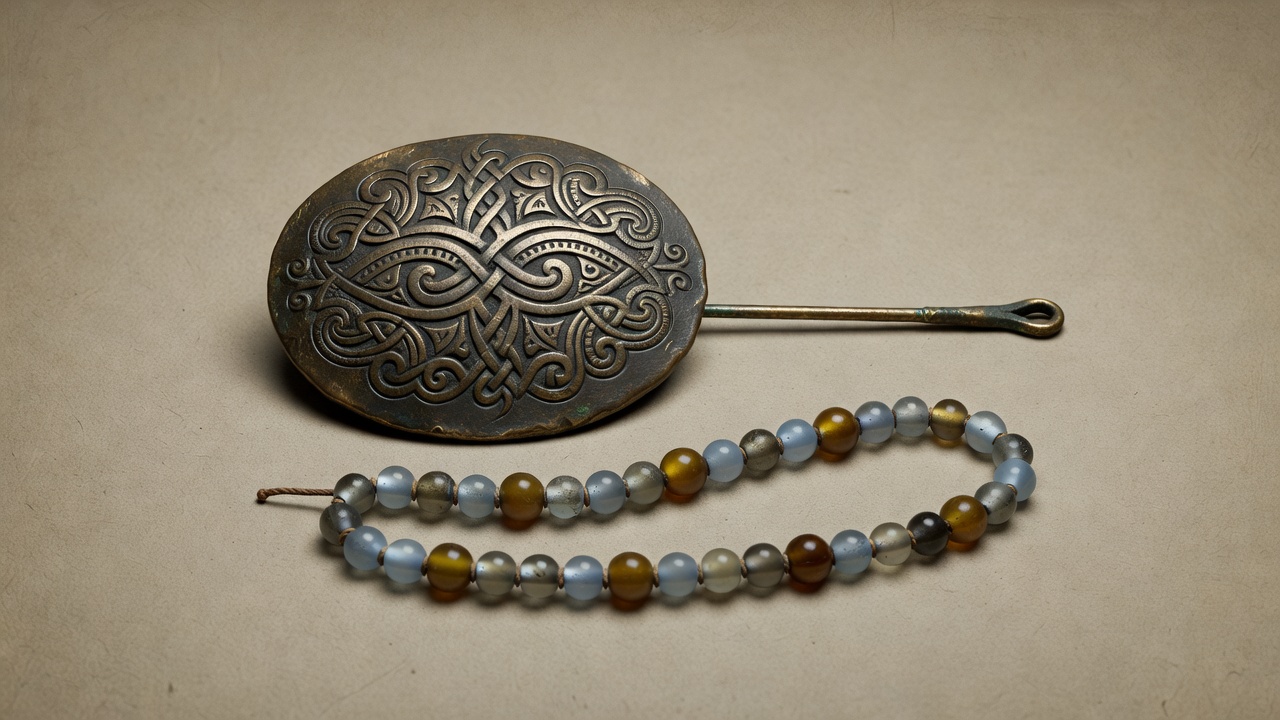
Paired oval brooches are familiar from many Viking Age graves associated with a particular form of women's dress. That association is useful, but it is not a universal Scandinavian costume rule. Distribution changes over time and across regions; graves without brooches also exist. Researchers combine object typology, skeletal analysis where possible, textiles and the arrangement of the burial rather than assigning an entire identity from one piece of metal.
A burial is a setting, not a snapshot
Birka, on Björkö in Lake Mälaren, supplies a rich body of grave evidence, including dress accessories and imported materials. Its importance should not make it stand for every Scandinavian settlement. A trading centre connected to long-distance exchange is a particular social environment. Objects placed in its graves reflect both lived relationships and decisions made during funerary preparation.
The Oseberg ship burial in Norway, dated to 834, is another powerful reminder of context. Exceptional preservation and extraordinary objects make it prominent, but also unusual. It cannot serve as an ordinary household wardrobe. Burial goods may have been selected for ceremony, memory or status display; some may have been old when deposited. An object's final resting place is only one stage of its history.
Evidence
A recorded pair of brooches can help reconstruct the arrangement of a burial's clothing.
Interpretation
The wearer used precisely that arrangement every day, or understood it exactly as we do.
Beads carry material histories
Glass, amber, stone and metal beads invite questions about production and movement. Their materials and manufacturing techniques can connect a local find to wider networks. Ribe in Denmark and Hedeby, near present-day Schleswig in Germany, are important places for considering craft and exchange. Yet an imported bead does not prove that its eventual owner travelled to the workshop where it was made.
Colour also deserves care. A bead's present surface may have changed through weathering, corrosion or conservation. Display lighting can alter our impression further. Laboratory work and detailed catalogues are better guides than a photograph when making claims about original appearance. The same caution applies to the length of a necklace: reconstructed strings may arrange surviving beads into a plausible display rather than preserve an original sequence.
Amber adds another useful distinction. Its presence establishes a material choice, and scientific analysis may help investigate origin. It does not, on its own, identify a personal belief, a healing practice or a cosmetic purpose. Those interpretations require independent evidence. A beautiful material can have several overlapping uses without leaving a written explanation of any of them.
Identity needs more than an object label
Pendants and amulets are often introduced through modern categories such as religion, gender or status. These can be productive questions, but they should not become automatic answers. A Thor's hammer pendant may support a discussion of religious symbolism; its meaning still depends on date, context and comparison. A cross pendant also belongs within a changing material and social landscape rather than a simple instant of conversion.
Personal adornment could communicate belonging, aspiration, affection or practical need. Archaeology can sometimes narrow those possibilities, but rarely recovers a private motive. Evidence from graves is also shaped by survival and excavation history. Objects from poorly documented early discoveries cannot always support the same precise conclusions as finds recorded with modern methods.
When reading a museum label, look for the find place, date range, material, accession record and any words signalling uncertainty. “Possibly,” “associated with” and “reconstructed” are not evasions. They show where the argument rests. The most rewarding question is not simply “What did Nordic people wear?” but “What can this particular object, in this particular setting, reasonably tell us?”