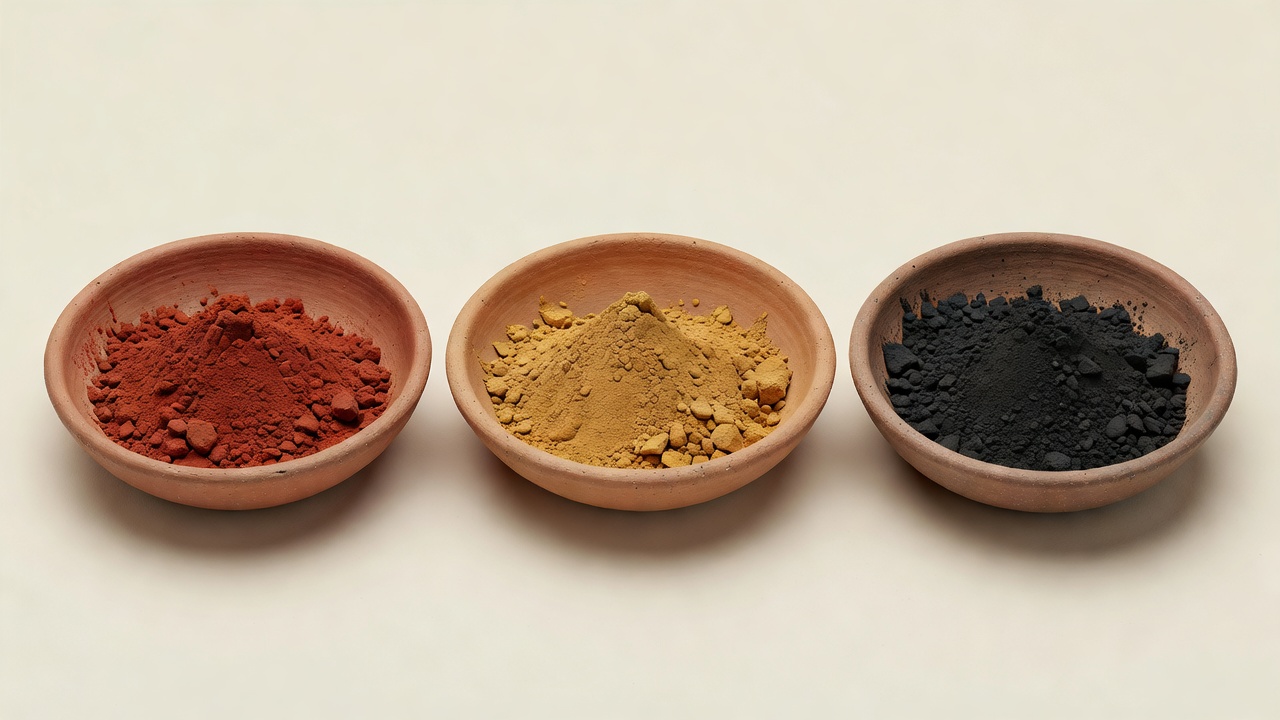
Identify the substance first
Natural colour begins with physical material. Red and yellow earth pigments commonly owe their colour to iron-bearing minerals. Charcoal supplies a carbon-rich black. Their broad availability makes them plausible historical resources, but availability is not proof of a specific use. The same material might be associated with painting, craft, marking, heating residues or deposits unrelated to deliberate colouring.
Archaeological interpretation therefore moves through several questions. What was found? Where was it found? How was it identified? What else occurred nearby? Microscopy, mineral analysis and chemical techniques can help distinguish a colourant from corrosion or ordinary soil. No single technique automatically reveals an intention. An analysed substance and a reconstructed activity remain different kinds of statement.
A container is part of the argument
A small bowl may look exactly right for mixing a cosmetic, but shape alone rarely settles its purpose. Researchers consider residues, wear, capacity, associated tools and the depositional setting. A loose powder from an old collection with no recorded context is less informative than a carefully sampled deposit inside a securely excavated vessel. Conservation materials and later handling can also complicate analysis.
Even a reliable identification of ochre would not, by itself, establish application to skin. A stronger claim would need a suitable association or other independent support. Conversely, the absence of a surviving residue does not prove that colour was never used. Organic materials decay, containers are cleaned, and excavation methods have changed. The honest position may be that a possibility remains unconfirmed.
Keep the provenance trail visible
The table separates general material knowledge from claims about Nordic grooming. It is a reading aid, not a list of substances established as Scandinavian cosmetics. A useful provenance trail connects the material to a find, the find to a dated context, and the interpretation to a published method.
| Material | Relevant evidence | Limit to remember |
|---|---|---|
| Iron-rich ochre | Mineral identification and secure archaeological context. | Red colour alone cannot establish skin application. |
| Charcoal or soot | Carbonaceous residue with contextual analysis. | Burning and craft can explain a black deposit. |
| Madder | Characteristic dye compounds may survive in textiles. | A dyed textile is not evidence of face paint. |
| Weld | Botanical dye identification in a suitable sample. | The precise plant source can require additional evidence. |
| Birch-derived materials | Plant remains, tar or chemical markers in context. | Different plant products have different histories and uses. |
Trade further complicates provenance. Identifying a plant-based dye does not necessarily show that the plant grew beside the settlement. Raw materials, processed colourants and finished cloth could all move. A local find can preserve evidence of a long supply chain.
Botanical familiarity is not historical continuity
Birch, juniper and nettle appear frequently in modern discussions of Nordic tradition. Each has a genuine botanical identity, but an attractive contemporary association is not a dated historical record. A plant might be represented as pollen, seeds, wood or a written name, and those forms of evidence answer different questions. Pollen can describe a surrounding environment without establishing a grooming practice.
Later herbals are valuable in their own setting. Henrik Harpestreng, associated with medieval Danish medical writing, belongs to a different evidential world from Viking Age excavation. His name should not be used to move a later preparation several centuries backwards without support. The same rule applies to early modern household recipes and nineteenth-century folklore collections: their date is part of their meaning.
Traditional ingredients also deserve a modern safety boundary. Plants may irritate or sensitise skin; mineral powders can contain harmful contaminants. Historical descriptions do not provide a tested formulation, a reliable concentration or permission for use near the eyes. This collection explains evidence rather than offering recipes or encouraging experiments on the body.
Let uncertainty remain informative
Natural colour can reveal technical knowledge even when its cosmetic role is unknown. Preparing a dye bath, grinding a mineral or handling a binder involves choices about resources and skill. Those histories are interesting without turning every vessel into a beauty product. A careful account can celebrate ingenuity while refusing a claim the evidence cannot carry.
When you encounter a striking “Viking makeup” claim, ask for the actual find, its date, the analytical report and the steps linking material to application. If those are absent, describe the image as a modern interpretation. That modest change in wording preserves curiosity while keeping reconstruction separate from discovery.