Period labels are useful boundaries
“Nordic” and “Scandinavian” are not interchangeable in every historical discussion. Scandinavia usually centres Denmark, Norway and Sweden, while Nordic can include a wider geographical frame. This collection names particular places whenever possible rather than assuming one shared experience. It also treats period labels as working tools, not moments when daily habits changed overnight.
The Viking Age is often dated approximately 750–1050, although boundaries vary by region and scholarly convention. Combs, ornaments and hair management have much longer histories. Earlier material can establish comparison, but it cannot be imported into a later period without argument. A prehistoric hairstyle, a medieval herbal and a modern folk custom belong to separate evidential settings.
Connected settlements, varied habits
During the Viking Age, places such as Birka, Ribe, Hedeby and Kaupang connected people, materials and craft knowledge. Imported beads and manufactured combs make some of those connections visible. Urban and trading evidence can be especially rich, but an excavated market settlement is not a random sample of every household. Rural communities had their own resource choices and patterns of survival.
Movement creates possibilities rather than guarantees. A new material might arrive through exchange without bringing an entire grooming custom with it. A familiar object might be made locally from non-local raw material. Differences in decoration, construction and distribution therefore matter. They allow a history of several connected practices instead of a single costume labelled “Viking.”
Burial customs also shape what appears to change. When fewer objects are placed in graves, the archaeological visibility of adornment can decline even if people continue wearing ornaments. Settlement finds, workshop debris and written evidence become important counterweights. A missing object category in one source is not automatically a vanished activity.
Medieval change was uneven
Christianisation and the growth of medieval towns altered institutions, public display and burial practice over extended periods. These changes affected the evidence available to historians as well as the lives being studied. A shift in funerary custom can remove a source of dressed burials; expanding towns can create new deposits of discarded household objects.
Clothing and head coverings provide another context for grooming. Hair might be arranged in relation to work, age, social position, religious expectations or changing fashion. Written prescriptions tell us about desired behaviour and authority, but not necessarily about universal compliance. An instruction is evidence that someone promoted a rule, not proof that everybody followed it.
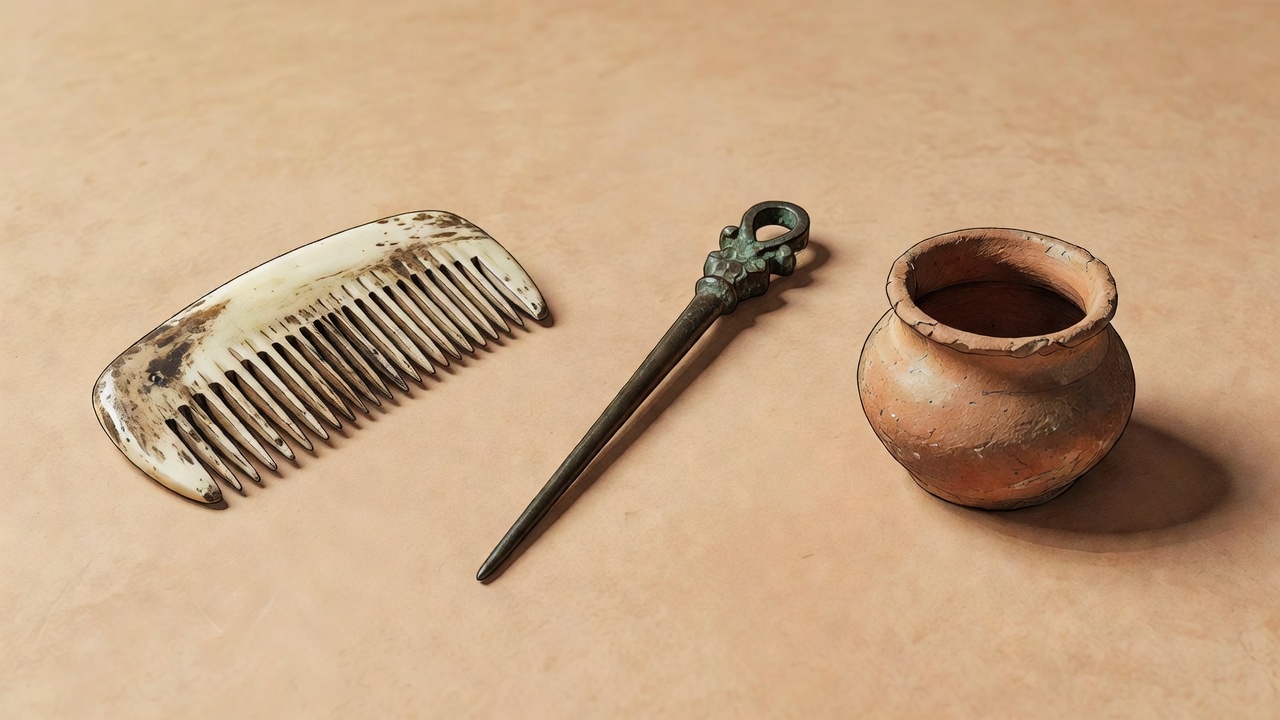
Medieval combs and grooming implements show both continuity and altered forms. Their persistence helps resist the idea that a political or religious transition erased ordinary habits immediately. At the same time, continuity in the general category “comb” should not conceal changes in material, workshop organisation or ways of carrying and displaying the object.
A compact chronology
- Earlier prehistoric and Iron Age contextsPreserved hair, dress fittings and combs provide period-specific comparisons, not a ready-made Viking wardrobe.
- Approximately 750–1050Viking Age settlements and graves reveal diverse grooming tools, dress accessories and exchange networks.
- Medieval centuriesChanging burial practices, towns and written sources reshape both habits and the surviving record.
- Early modern periodPortraits, household writing and printed texts add sources that require attention to audience and social setting.
- Nineteenth and twentieth centuriesIndustrial production, retail and advertising alter access to grooming goods and the language used to sell them.
Later traditions have their own history
Folklore collections and household memories can preserve valuable knowledge about plants, washing and personal presentation. Their value increases when their recording circumstances are visible. Who supplied the account? Where and when was it recorded? Was the collector describing a current practice, a remembered one or an idealised past? Those questions prevent a documented later custom from becoming an unsupported ancient survival.
Industrial materials and commercial cosmetics introduce further change. Mass-produced combs and packaged preparations can reach consumers through different networks from craft-made antler tools. Advertisements reveal ideals and selling strategies, but not an exact record of every buyer's routine. A product's marketing language also cannot certify that its claimed “traditional” origin is historically continuous.
The most useful long view holds resemblance and difference together. People across many periods cared for hair and appearance, but they did so with different resources, meanings and constraints. Following an object through its context avoids both extremes: a timeless romantic tradition and a story of uninterrupted progress towards modern beauty. History is more specific, and more interesting, than either.